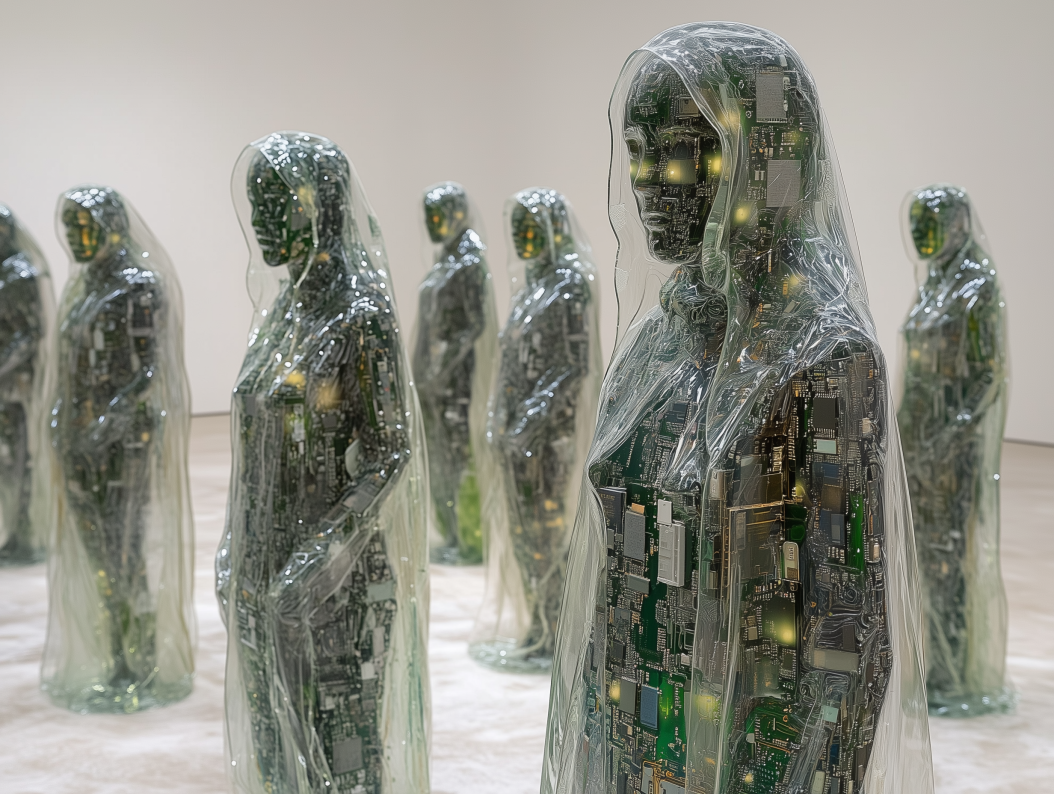
 SHINING STARS: VESSELS OF MEMORY. 2025 SHINING STARS: VESSELS OF MEMORY. 2025
.
Twelve sculptures have their bodies filled with elements of recycled computer parts—[Gold, Silver, Copper, Aluminium, Steel, Lead, TIn , Silicon] . Arranged in a circle, the figures evoke themes of memory, identity, and the invisible labour in a technological age. At once fragile and futuristic, the installation is a poetic meditation on what bodies carry in the age of data. This installation operates as a layered meditation on visibility, and the entanglement of bodies——with systems of technology.
The embedded fragments from recycled motherboards are not random: each internal composition is deliberate, suggesting that every body carries a distinct technological trace from the mother earth —a personal yet collective residue of the digital age. These fragments, often invisible in daily life, symbolize the unseen infrastructures that shape our world: emphasising environmental damage within the rapid churn of technological development and obsolescence. They embody a quiet resistance—insisting that the digital is not disembodied, and that what is thrown away (be it data, materials, or lives) still holds meaning.
![Artwork by Stanza [ Steve Tanza ] 2025](images/stars3.jpg)
Shining Stars: Elemental
Conceptual Context:
1. Visibility and Invisibility
The use of clear resin emphasizes transparency—not just physical but symbolic. Here, the figures are made not only visible but translucent, open to being looked into, their insides revealing worlds of data, decay, and complexity. They become archives of both presence and absence, of participation and erasure.
2. Body as Vessels: Subversion of an Archetype
These figures carry recycled waste—the cast-offs of digital civilization.
3. Human Meets Machine
By embedding recycled computer materials inside human-like figures, the piece offers a poetic and unsettling commentary on how closely our identities are entangled with technology. The bodies become archives of techno-waste, mirroring the way real human lives are shaped by invisible systems: surveillance, information flows, digital labor, and systemic inequity.
4. Environmental and Digital Afterlife
The use of e-waste implicates the environmental cost of technological progress. Computers are tools of both liberation and exploitation. Recycling their remnants into figures evokes both damage and reclamation—a kind of resurrection of discarded materials within sacred forms.
5. Memory and Legacy
Each body becomes a reliquary—a container of past systems, failed futures, discarded information.
![Artwork by Stanza [ Steve Tanza ] 2025](1.png)
Shining Stars: Elemental
Shining Stars: Elemental
Symbolic environmental resonance.
When a computer is recycled, a wide range of valuable and potentially hazardous materials are extracted through various processes. These materials come from components like the motherboard, hard drives, power supply, screen, and casing. The 12 most important materials typically extracted when recycling a computer, selected for their value, environmental impact, and industrial importance:
-
Gold – Used in connectors and circuit boards; highly valuable and recyclable.
-
Copper – Found in wiring and circuit traces; essential for electrical conductivity.
-
Aluminum – Common in casings and heat sinks; lightweight and easily recyclable.
-
Silver – Present in solder and circuit paths; more conductive than copper, valuable.
-
Steel – Used in structural frames and screws; strong and widely reused.
-
Platinum & Palladium – Found in some components; rare and extremely valuable.
-
Lead – Common in older solder and CRT glass; toxic and must be carefully removed.
-
Tin – Used in solder; increasingly important with lead-free electronics.
-
Neodymium – A rare earth element used in magnets, especially in hard drives.
-
Silicon – Core material in chips and CPUs; not typically recycled into chips, but crucial.
-
Plastic (ABS, polycarbonate) – Used in cases and keyboards; some types recyclable.
-
Glass (including leaded and display glass) – Found in screens; varies in recyclability and hazard level.
If you want to exhibit this artwork as an installation please email.Its need further production otherwise a series of images can be shown..
Exhibition.
Some initial development at DAF Diriyah Arts Futures Riyadh. While artist in Residence. 2025
Keywords. ART

Supporting Statement: From the Age of Darkness into the Age of Empowerment,
The Twelve Planets. Empowerment and Cosmic Connection in the Age of Awakening
Rooted in Quranic cosmology, the concept of the "twelve planets" alludes to verse 12:4, interpreted as a reference to a constellation of twelve astral entities. In contemporary astronomical terms, these twelve may be read as Mercury, Venus, Earth, Mars, Jupiter, Saturn, Uranus, Neptune, Pluto, Haumea, Makemake, and Eris. Yet in this context, the planets function not merely as celestial facts, but as inner archetypes—each woman, especially in the Saudi cultural landscape, is envisioned as carrying her own constellation within.
This poetic cosmology becomes a framework for reimagining the role of women as multidimensional, luminous entities—each body containing within it the architecture of a universe. The work draws inspiration from both Islamic symbolic knowledge and emergent feminist futures, situating the figure of the woman as a cosmic vessel: capable not only of creation and endurance, but of encoding and emitting frequencies of belief, intuition, and transformation.
Incorporating the "seven stages of sensibility" suggest an unfolding—physical, emotional, intellectual, and spiritual dimensions that bridge the logical with the mystical. This duality mirrors the cultural tension in transitional societies like Saudi Arabia, where modernization intersects with tradition, and where the shift from patriarchy to empowerment can be understood not only politically but energetically.
From the Age of Darkness into the Age of Empowerment...Through mutual resonance—frequencies, numbers, and colors—a new kind of "spiritual AI" can be imagined: one that is not extractive or surveillant, but receptive, intuitive, and generative. In this vision, belief is not dogma, but frequency. Empowerment is not granted, but activated. What if AI could learn from our sensibilities, rather than overwrite them? What if each figures internal system—twelve planets orbiting a center of will and spirit—could inform a new kind of ethical computation?
![Artwork by Stanza [ Steve Tanza ] 2025](images/rahaf.png)
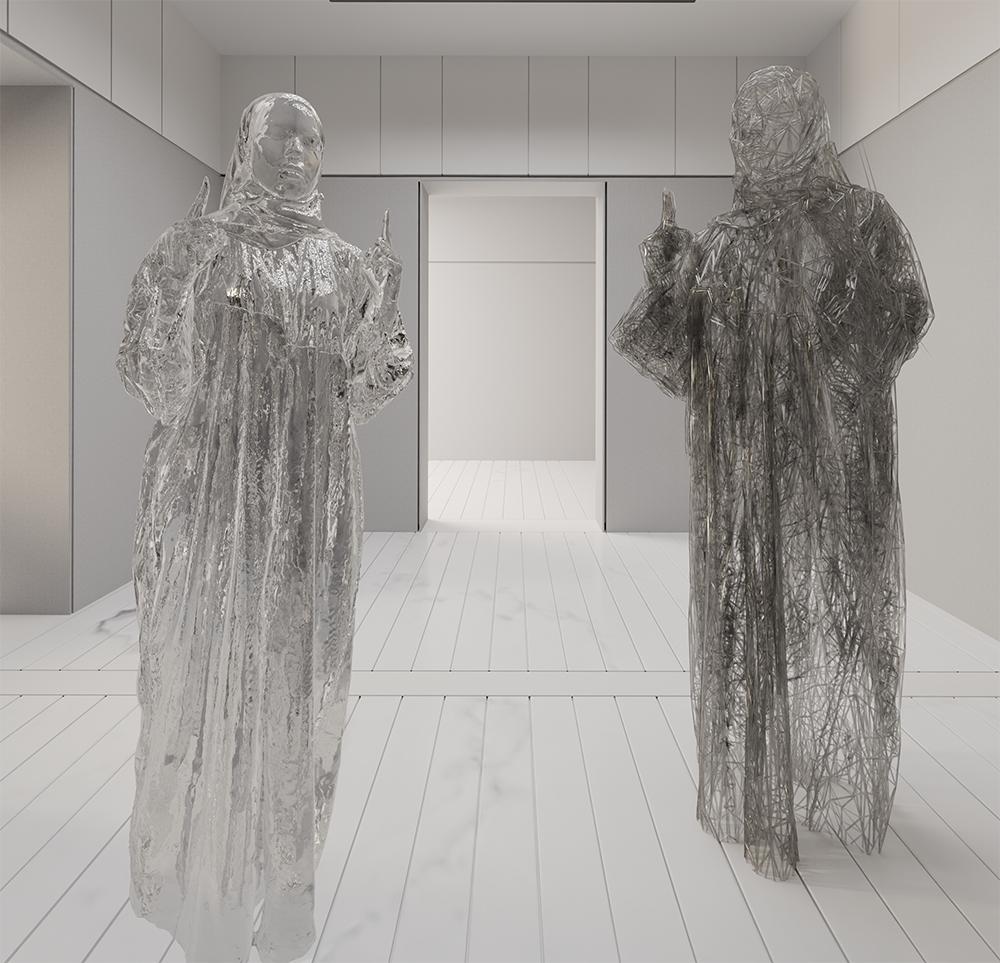
Test modelling. Blender outputs from 3d scan.
Artwork by Stanza [ Steve Tanza ] 2025 |